 Book a strategy call
Book a strategy call
Book a strategy call

Como case study
A case study on buying before the market makes the opportunity obvious.
The deal
An off-market, direct-from-owner two-bedroom unit in Como.
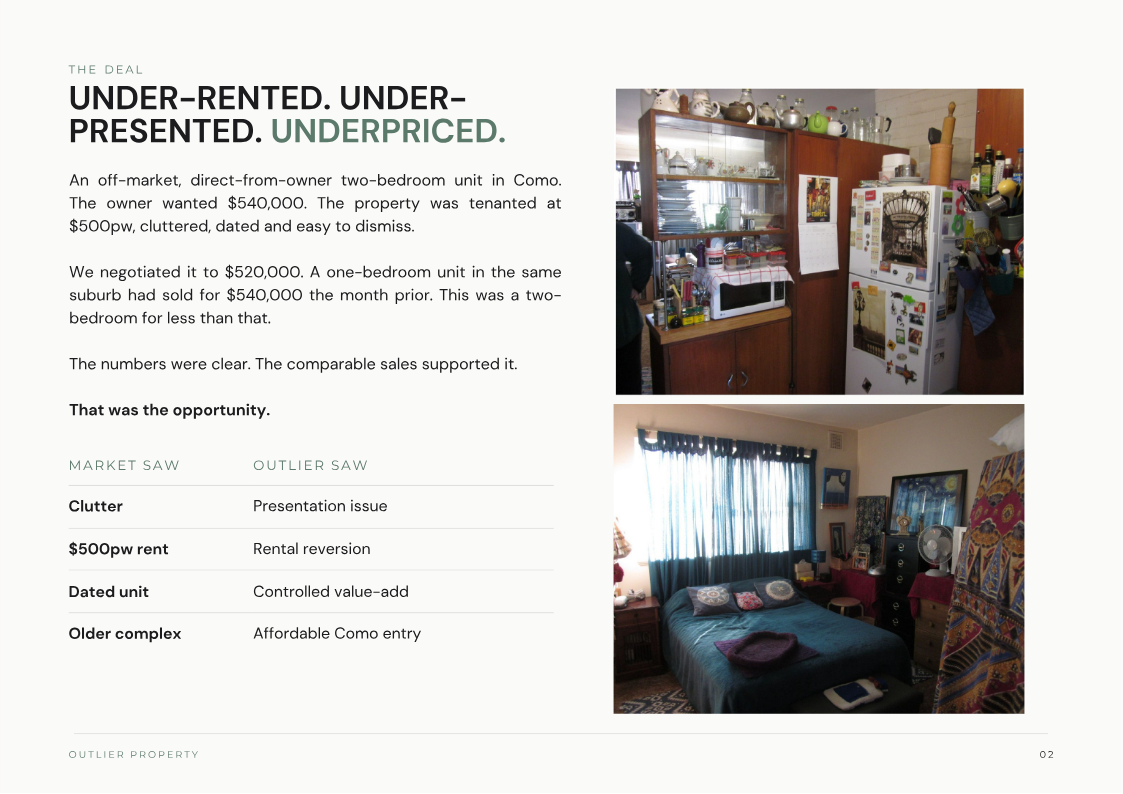
The owner wanted $540,000. The property was tenanted at $500pw, cluttered, dated and easy to dismiss.
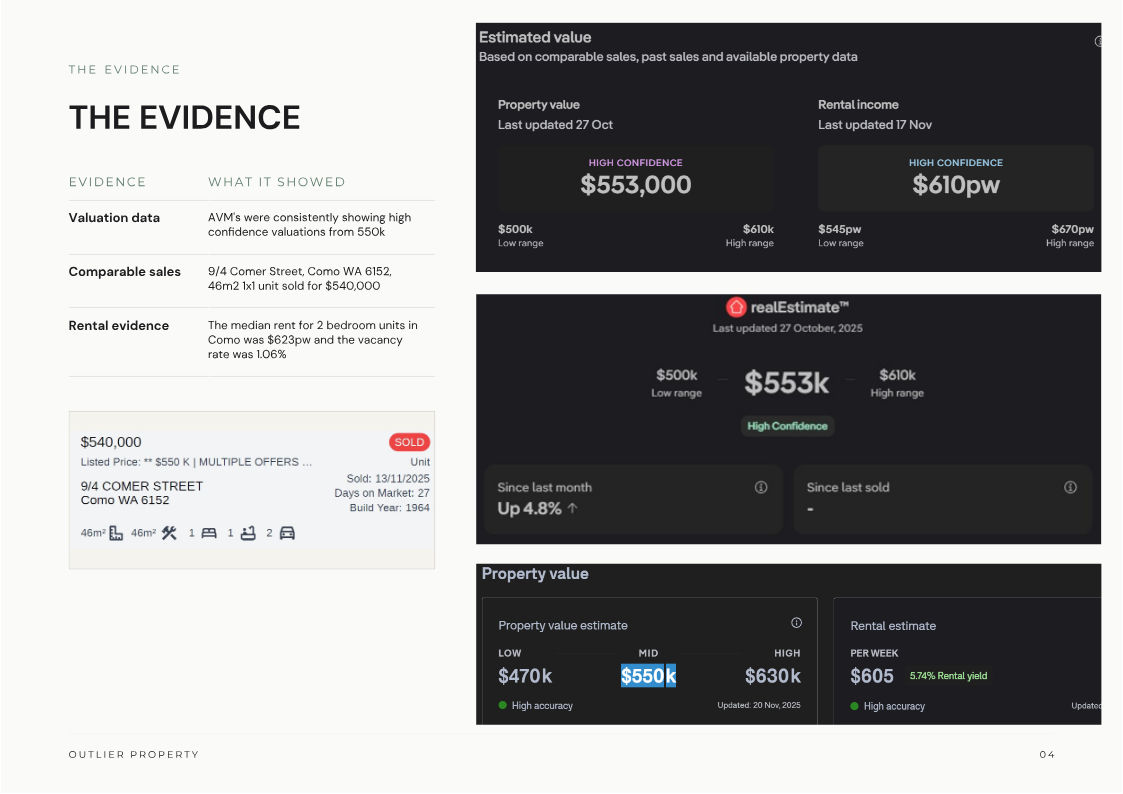
We negotiated it to $520,000. A one-bedroom unit in the same suburb had sold for $540,000 the month prior. This was a two-bedroom for less than that.
The numbers were clear. The comparable sales supported it. That was the opportunity.
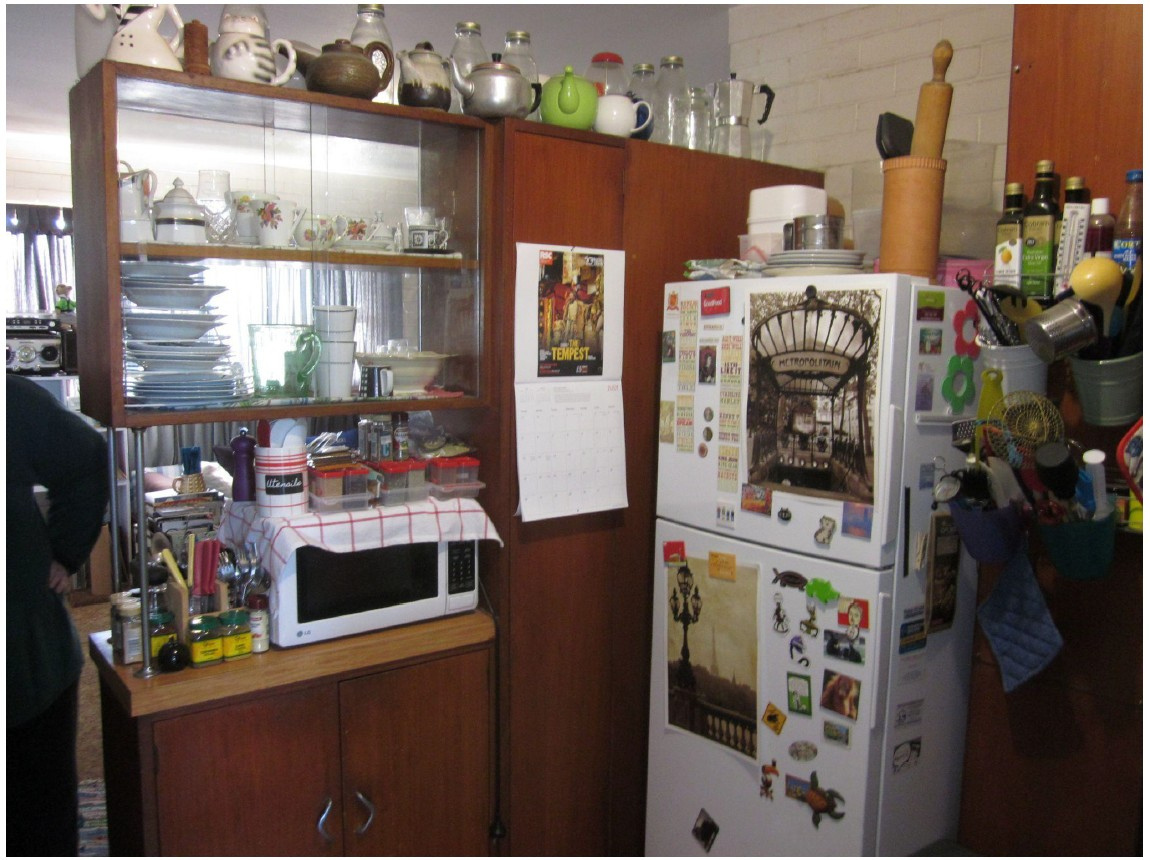
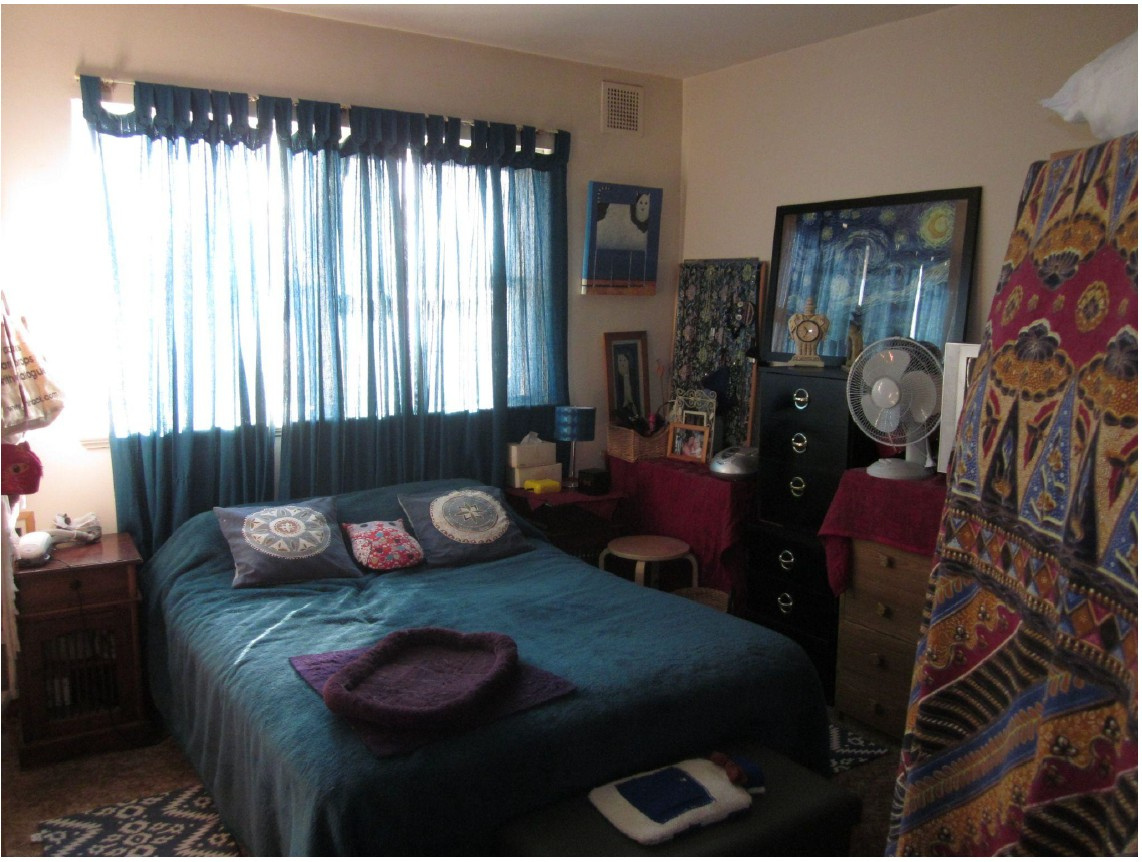
| Market saw | Outlier saw |
|---|---|
| Clutter | Presentation issue |
| $500pw rent | Rental reversion |
| Dated unit | Controlled value-add |
| Older complex | Affordable Como entry |
The client / The strategy
The client was ambitious and wanted to build a 10-property portfolio.
He had sold his owner-occupier home, held around $300,000 in cash and wanted to begin his investment plan properly.
He was living lean, renting a room with family, keeping his costs low and saving aggressively. That mattered.
This property gave him options. He could buy it, move in, renovate progressively and later retain it as a rental.
Under the ATO main residence exemption, a property can continue to be treated as your principal residence for up to six years after you stop living in it, provided you lived there first and later used it to produce rental income.
The strategy required him to move in first and establish it as his genuine main residence. He was already living lean. He had the holding capacity. The pieces were there.
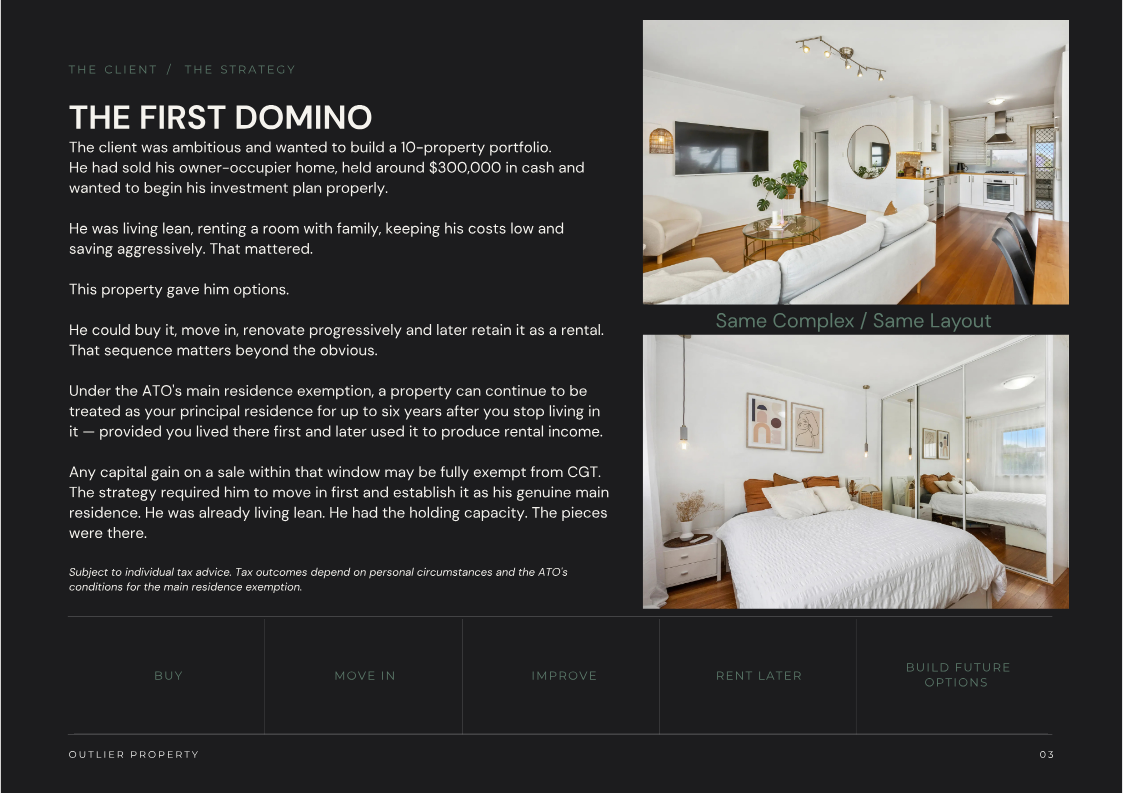
Below are images of a unit in the same complex with the same floor plan.
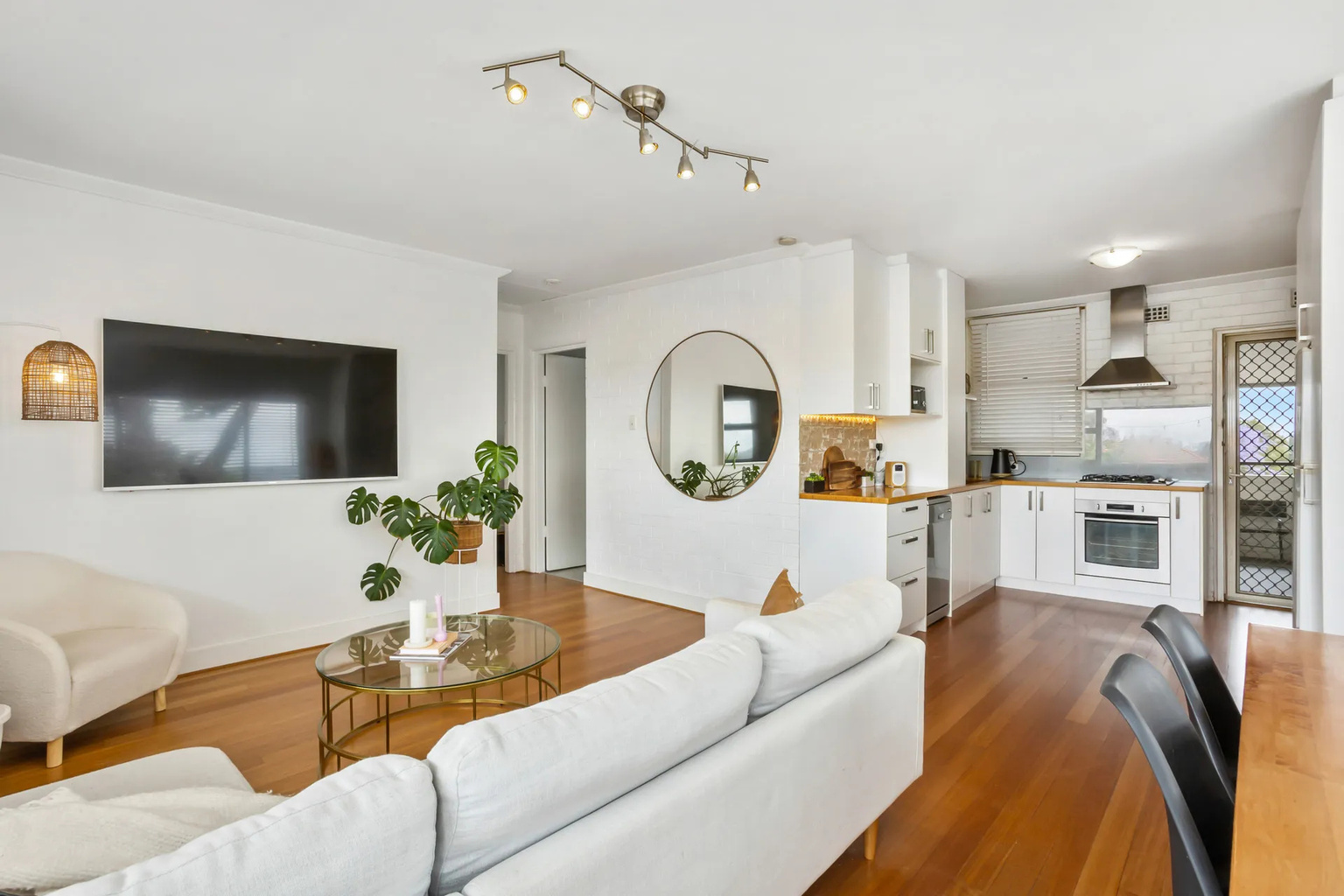
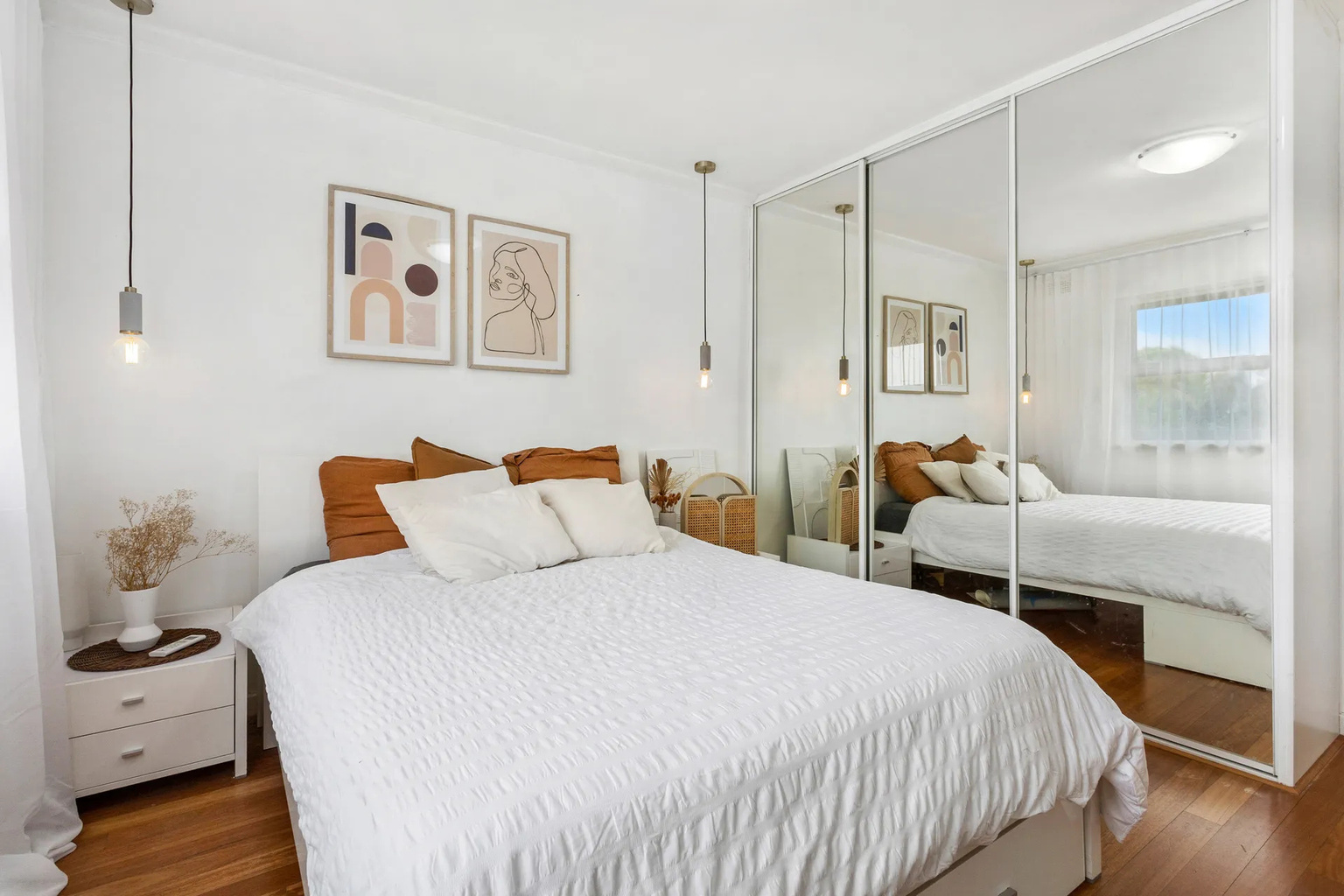
Subject to individual tax advice. Tax outcomes depend on personal circumstances and the ATO conditions for the main residence exemption.
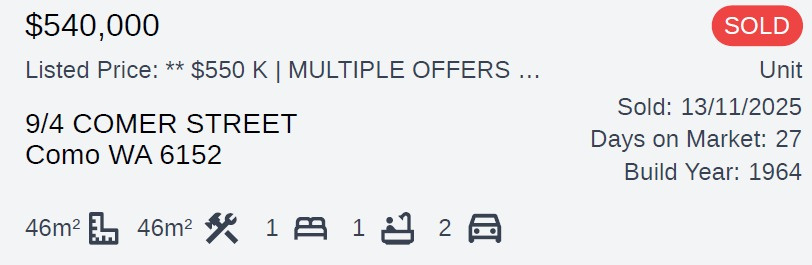
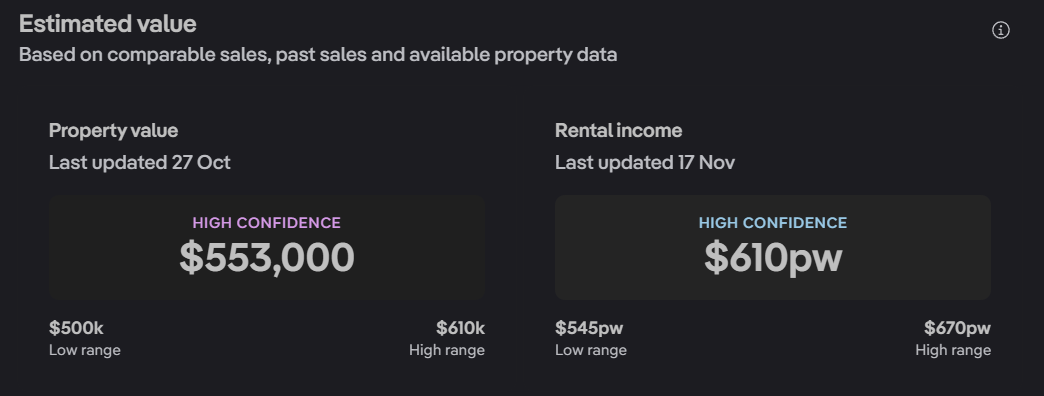
Decision risk
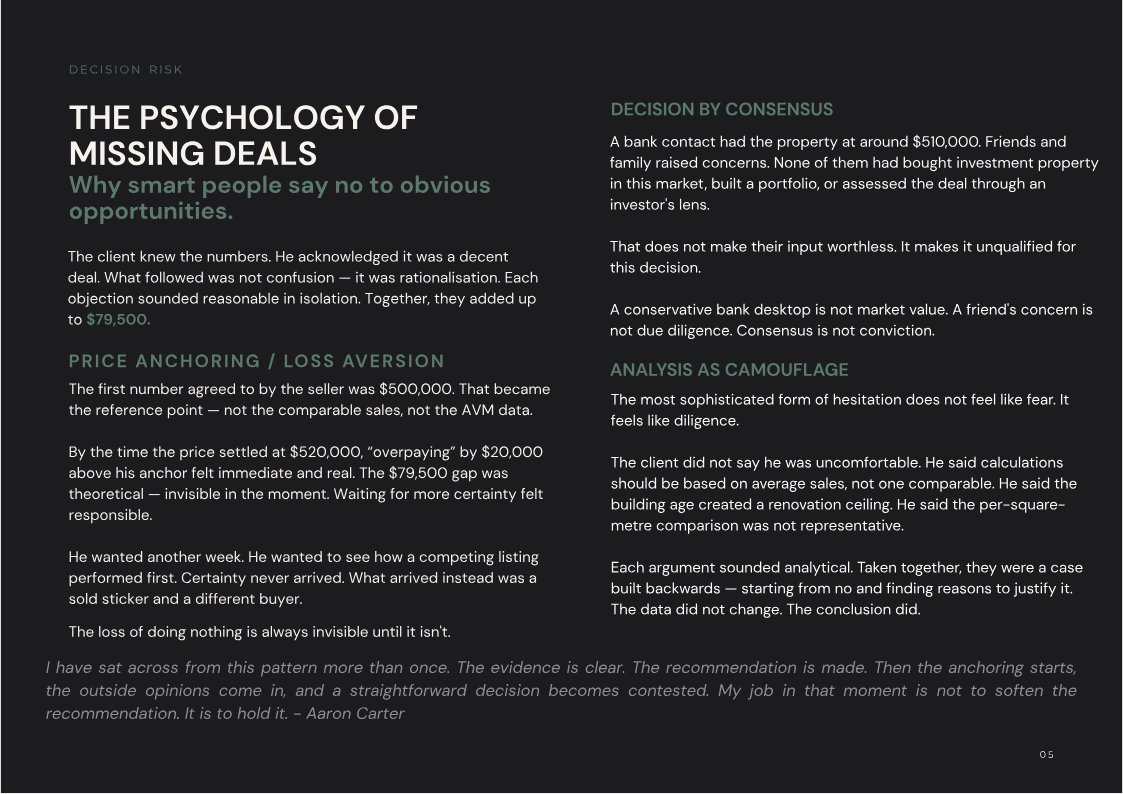
The client knew the numbers. He acknowledged it was a decent deal. What followed was not confusion. It was rationalisation.
Each objection sounded reasonable in isolation. Together, they added up to $79,500.
The first number agreed to by the seller was $500,000. That became the reference point, not the comparable sales, not the AVM data.
By the time the price settled at $520,000, "overpaying" by $20,000 above his anchor felt immediate and real. The $79,500 gap was theoretical and invisible in the moment.
Waiting for more certainty felt responsible. He wanted another week. He wanted to see how a competing listing performed first. Certainty never arrived. What arrived instead was a sold sticker and a different buyer.
The evidence is clear. The recommendation is made. Then the anchoring starts, the outside opinions come in, and a straightforward decision becomes contested. Aaron Carter
| Price anchoring / loss aversion | The $500,000 anchor felt more real than the opportunity cost. |
|---|---|
| Decision by consensus | A bank contact and friends became louder than market evidence. |
| Analysis as camouflage | The most sophisticated form of hesitation felt like diligence. |
Client objection / Decision risk
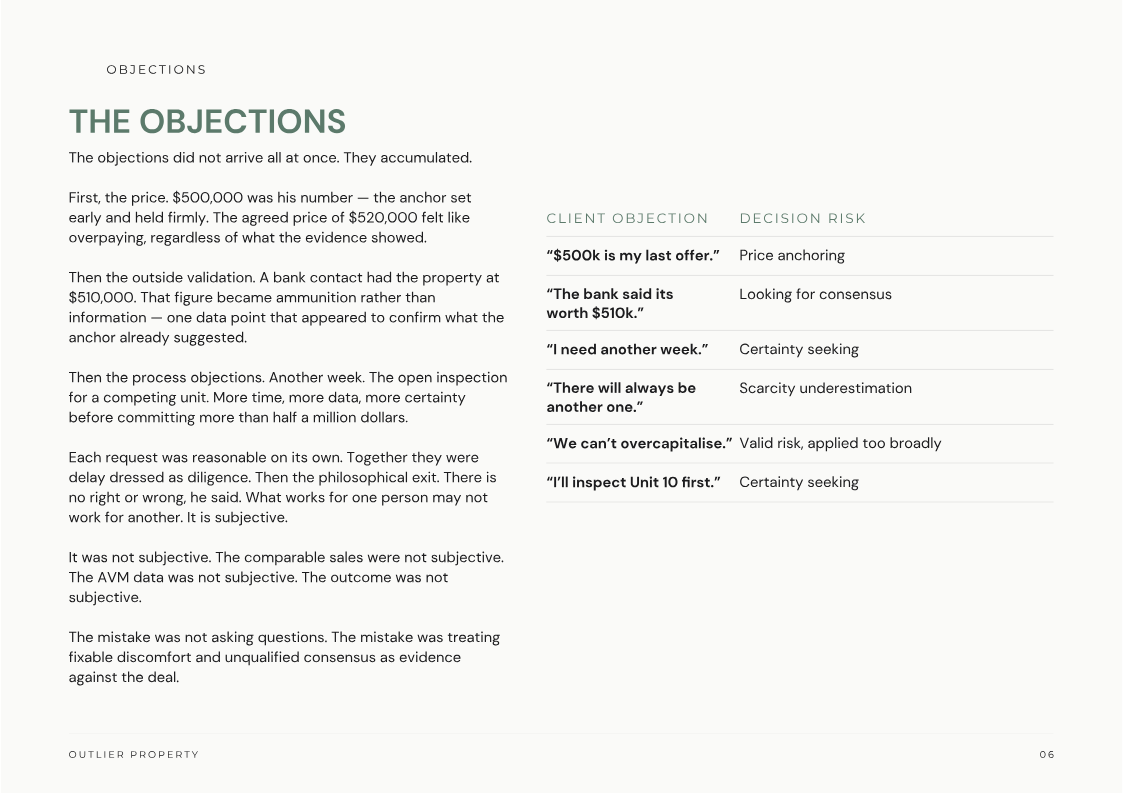
The objections did not arrive all at once. They accumulated.
First, the price. $500,000 was his number, the anchor set early and held firmly. The agreed price of $520,000 felt like overpaying, regardless of what the evidence showed.
Then the outside validation. A bank contact had the property at $510,000. That figure became ammunition rather than information.
Then the process objections. Another week. The open inspection for a competing unit. More time, more data, more certainty before committing more than half a million dollars.
Each request was reasonable on its own. Together they were delay dressed as diligence.
It was not subjective. The comparable sales were not subjective. The AVM data was not subjective. The outcome was not subjective.
Market context
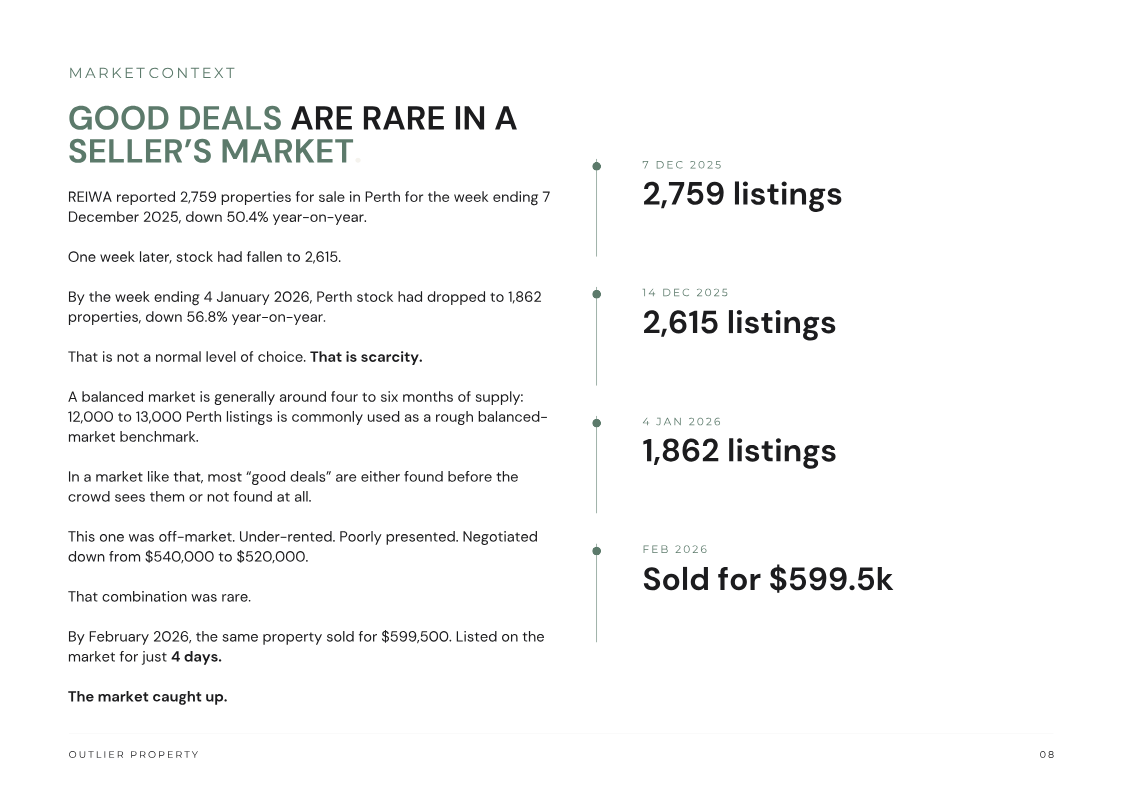
REIWA reported 2,759 properties for sale in Perth for the week ending 7 December 2025, down 50.4% year-on-year.
One week later, stock had fallen to 2,615. By the week ending 4 January 2026, Perth stock had dropped to 1,862 properties, down 56.8% year-on-year.
That is not a normal level of choice. That is scarcity.
A balanced market is generally around four to six months of supply. 12,000 to 13,000 Perth listings is commonly used as a rough balanced-market benchmark.
In a market like that, most good deals are either found before the crowd sees them or not found at all.
This one was off-market, under-rented, poorly presented and negotiated down from $540,000 to $520,000. That combination was rare.
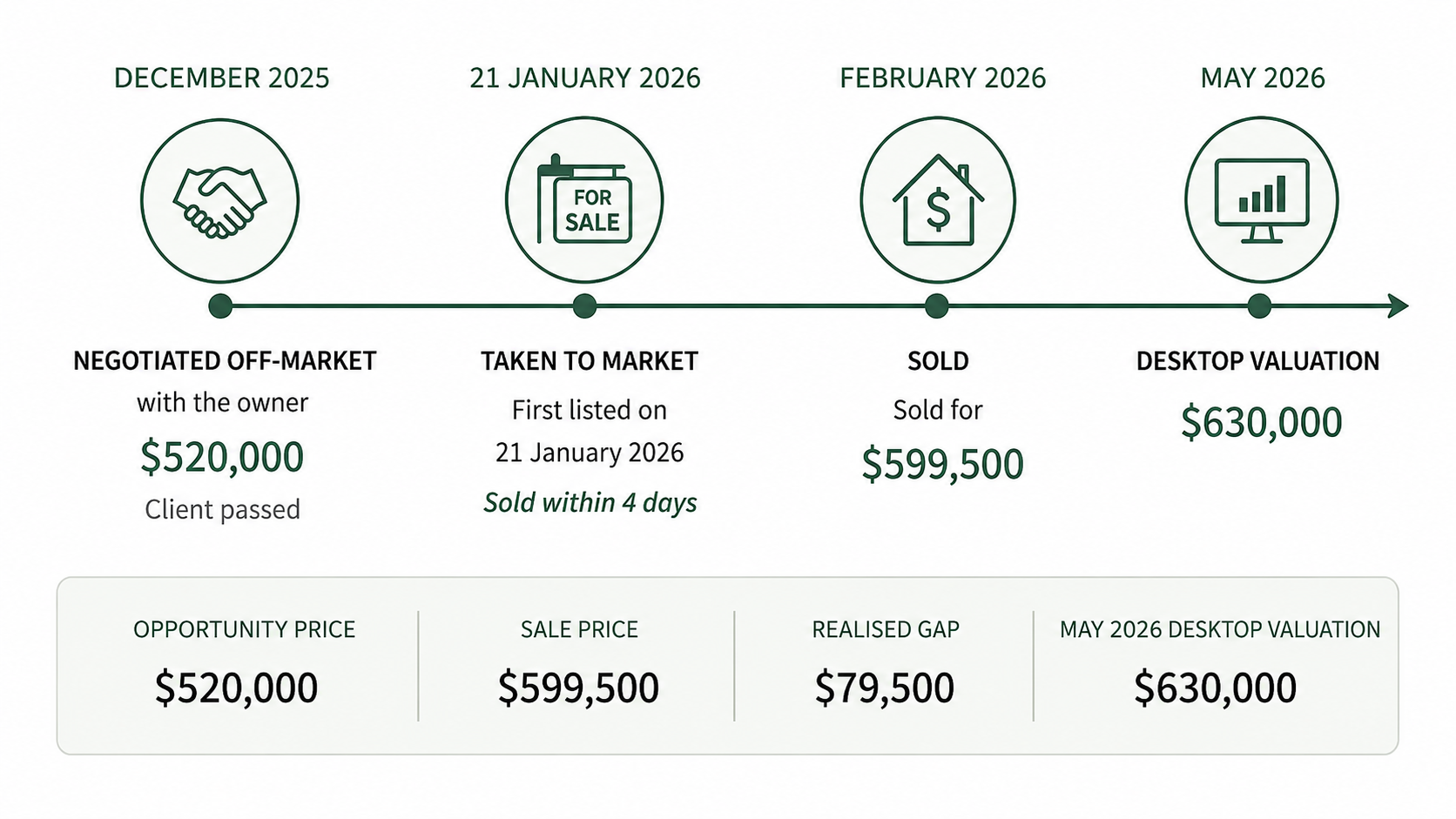
By February 2026, the same property sold for $599,500. Listed on the market for just four days. The market caught up.
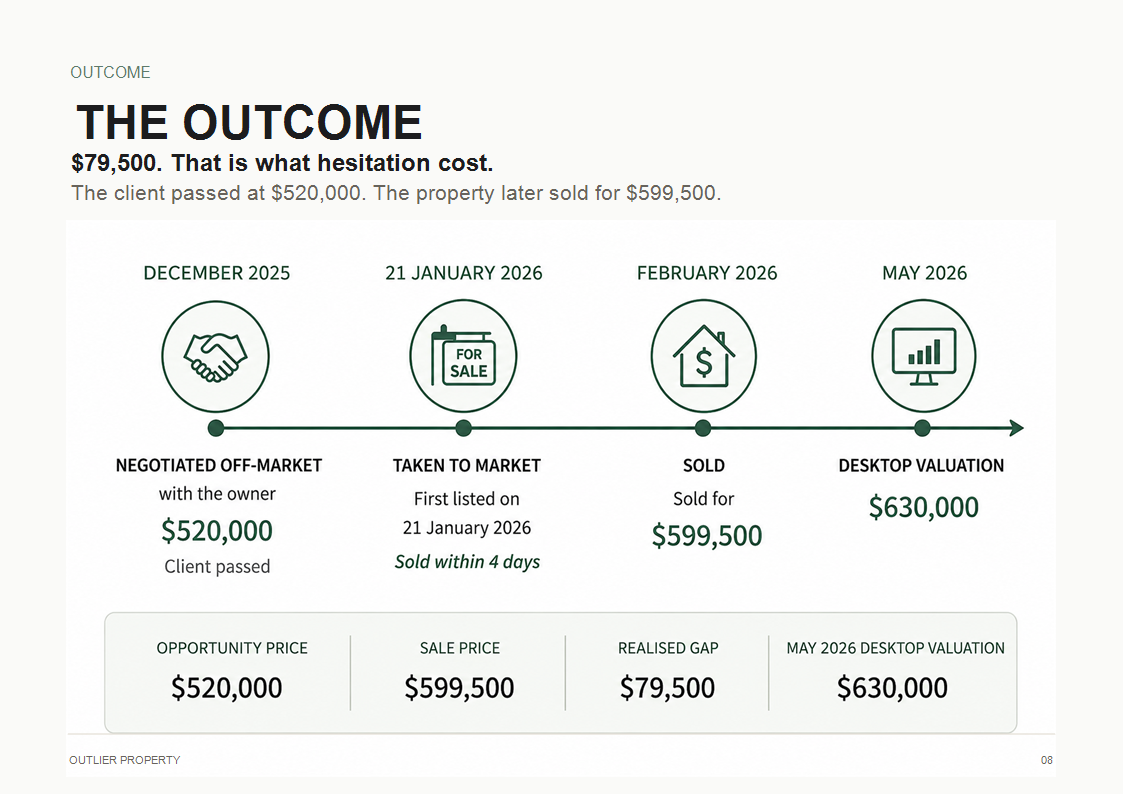
$79,500. That is what hesitation cost.
The client passed at $520,000. The owner took the property to market. It sold for $599,500. Listed for 4 days on market.
The clean, measurable gap was $79,500.
We do not need to add hypothetical rent, assume renovation uplift or assume a tax outcome. The sale result alone tells the story.
Next step
If you recognised something in this story, in yourself or in the way you have approached decisions before, that recognition is worth a conversation.
I work with a small number of clients at a time, by design. Every engagement gets full attention, full diligence and a clear recommendation, including when the answer is to wait.
A strategy call covers your brief, your timeline, your borrowing position and whether the current market fits your criteria. Thirty minutes. No obligation after it.

This case study is provided for general information and marketing purposes only. It does not constitute financial, investment, taxation or legal advice. Figures are based on information available at the relevant time, third-party data sources, publicly available market information and later sale/valuation information. Past performance is not a reliable indicator of future performance. Buyers should obtain independent taxation advice before relying on any tax strategy.